Showing posts with label antler. Show all posts
Showing posts with label antler. Show all posts
Sunday, January 25, 2015
Big 14 point buck in Missouri.
This buck teased me all summer near Eureka MO. Then the new neighbors decided to trespass with four wheelers and even put up a camera next to mine. The good news - next year he will be even better!!!

Thursday, December 4, 2014
Hunter becomes the hunted after shooting famous albino deer
Hunter becomes the hunted after shooting famous albino deer

Kinnaman bagged the buck — which was called “arguably Cape Girardeau’s most notorious deer” by the Southeast Missourian. It was a legal kill, but a controversial one.
“This is a buck of a lifetime,” he told the newspaper.
“Not my biggest buck but at 7 1/2 years old he might be the oldest,” Kinnaman wrote on Facebook. “Let the bashing begin!”
And it did. Kinnaman said in an interview with The Washington Post on Thursday that it has gotten so bad, he has received death threats over the deer.
“People are all tough on the computer,” he said, “but it’s easy for them to say that because they know they’re not going to get in trouble for it.”
The deer was something of a celebrity in Cape Girardeau. Kinnaman said that some locals felt a connection to it and would notice the animal on drives through the city.
“I was the same way as anybody else about this deer, so I understand the relationship some of these people have,” he said.
Here’s the thing, though: The deer wasn’t doing well, Kinnaman said. He said there was “not an ounce of fat on him,” and Kinnaman’s taxidermist noted that the deer’s teeth were in poor condition. The animal would have died this year, Kinnaman said, whether he harvested it or not.
“They never even thought about how hard it would be for this deer to survive once he got to a certain age,” he said.
For what it’s worth, Kinnaman contacted a local conservation department office and was told that he hadn’t broken any regulations. After his taxidermist is finished, Kinnaman said he might donate the mount to a local nature center, so Cape Girardeau residents can continue to see the deer.
“There’s a lot of rumors I shot this deer for a reward,” he said. “I’m, like, ‘no.’ ”
The kill — and subsequent backlash — follows a similar incident in Michigan, in which an 11-year-old boy bagged an albino buck. Gavin Dingman was crossbow hunting with his father, Mick Dingman, when he shot the deer in October.
“I’ve had people tell me, ‘You should have taken the shot. You don’t let an 11-year-old take a shot at a deer like that,’ ” Mick Dingman told the Daily Press & Argus. “To me, in my opinion, it doesn’t matter if it’s a spike or a doe or a trophy deer. If you have confidence in them, it shouldn’t matter what they are shooting at.”
Tuesday, December 2, 2014
Missouri Bow Hunter Takes Rare Albino Buck

After years of practice, preparation, and patience, Jerry's plan finally came together on a cold December morning. As he sat quietly 24 feet in the canopy the elusive buck crept underneath. Jerry heard a small crunch as the buck stepped through the icy leaves. Without moving a muscle he slowly gazed to his left and spotted the buck creeping between the brush. Jerry's heart pounded. He could see his breath as it hit the bitter cold air. He slowly stood up as the buck passed behind a small tree, then as the buck passed a thick bush Jerry realized it would be his last chance to raise his trusty bow before this buck disappeared into the distance. Jerry held his bow and focused on his target. He said to himself, "Aim small, miss small" he quickly went through his shooting checklist. Grip-check, anchor-check, pin-check. He slowed his breathing and gently released the string. The arrow was true and the shot deadly. It pierced his heart and the great animal was down within 30 yards.
Jerry lowered his head. He had finally been given this wonderful opportunity. All of his practice and patience was worth it. He passed the test. He overcame the challenge. He hung is bow and crossed his frozen fingers. He said a prayer and thanked the Lord for blessing him with this hunt. He looked up and smiled like a little kid. He was filled with excitement and pride.
Shooting albino deer is somewhat controversial. Most hunters look at an albino as a rare opportunity and a trophy. Some believe they should be left alone because they are rare, yet evolution says that this is not a favorable trait.
How rare is an albino deer?
In a December 2013 report published by USA TODAY, Wisconsin naturalist John Bates, co-author of "White Deer: Ghosts of the Forest," said albino deer are born once in about 20,000 births. Some biologists claim only one in 100,000 deer is born albino, the report said. It is even more rare they they make it to this age. Truly amazing.
Thursday, March 22, 2012
Food Plots and Honey Holes - Preparing for deer season
The idea of making big, elaborate food plots that require heavy equipment and hours of labor tends to intimidate landowners. But there's a much simpler and cheaper way to join the food plot craze. Grant Woods, one of America's top whitetail biologists and head of a deer management consulting firm, creates and hunts over what he calls hidey holes. "They're just small woods openings where I sweeten the deal in a place where deer already like to go--like putting ketchup and mustard on a hot dog."
These micro food plots require few tools: a small sprayer with Roundup herbicide, one bag each of lime and fertilizer, a rake or a leaf blower, and some seed. Building the plot is simple, and you can backpack in everything you need in a trip or two.
THE PERFECT SPOT Think small. A quarter acre is as big as you'll want to go. "An excellent place is around the trunk of a big, old tree that's been lightning-struck or killed by gypsy moths," Woods says. "Suddenly there's an opening in the canopy where sun hits the ground for a good part of the day." Log landings (cleared areas where loggers have piled timber), woods roads, and natural openings also work.
Woods preps the seedbed by spraying grass or weeds with Roundup. "Woody brush will have to be girdled [the bark scarred with a knife or hatchet] first," he says. "But don't go through the headache of clearing out dead trees--just work around them. You're not creating a field here."
If leaf litter is all that covers the ground, Woods uses a gas-powered blower to remove leaves and sticks for maximum soil-to-seed contact. "A leaf blower is one of the handiest tools a food-plotter can have. Not only does it do a beautiful job of clearing out the plot itself, but it's also great for creating an entry and exit trail to your stand." If you don't have one, use a steel-tined garden rake instead.
With the debris gone, Woods applies pelletized lime and fertilizer (which breaks down more quickly than the powdered variety) with a handheld spreader. "This is an essential step," he stresses. "Nearly all woodland soils are so acidic that even if plants grow, they'll taste bitter to deer. So I spread as much lime and fertilizer as I can haul in a couple of trips."
TASTY TREATS Finally, broadcast the seed on top of the lime and fertilizer. Deciding what--and when--to plant is critical. "You have a very specific mission: having that plot at peak palatability to deer when conditions are right for you," Woods says. "Seed it too early, and deer can wipe out a plot before you hunt it."
In most areas you'll be planting about three weeks before the opening of bow season, then hunting the site a limited number of times, depending on the crop. You need to consider both its attractiveness and its durability. Deer love peas, for example, but can eat an entire plot in about a week. Clover also draws whitetails and will buy you several more days, depending on the population density. Brassica blends are another favorite, but they mature at different times and give you maybe a month to six weeks.
It takes about four hours to establish a micro plot, according to Woods. "Some folks say that given the little time you can hunt one, you'd be better off just scouting more. That's true if you have exclusive access to a large tract. But if you're hunting only a small acreage or sharing land with other hunters, hidey holes provide an edge that's worth the time."
These micro food plots require few tools: a small sprayer with Roundup herbicide, one bag each of lime and fertilizer, a rake or a leaf blower, and some seed. Building the plot is simple, and you can backpack in everything you need in a trip or two.
THE PERFECT SPOT Think small. A quarter acre is as big as you'll want to go. "An excellent place is around the trunk of a big, old tree that's been lightning-struck or killed by gypsy moths," Woods says. "Suddenly there's an opening in the canopy where sun hits the ground for a good part of the day." Log landings (cleared areas where loggers have piled timber), woods roads, and natural openings also work.
Woods preps the seedbed by spraying grass or weeds with Roundup. "Woody brush will have to be girdled [the bark scarred with a knife or hatchet] first," he says. "But don't go through the headache of clearing out dead trees--just work around them. You're not creating a field here."
If leaf litter is all that covers the ground, Woods uses a gas-powered blower to remove leaves and sticks for maximum soil-to-seed contact. "A leaf blower is one of the handiest tools a food-plotter can have. Not only does it do a beautiful job of clearing out the plot itself, but it's also great for creating an entry and exit trail to your stand." If you don't have one, use a steel-tined garden rake instead.
With the debris gone, Woods applies pelletized lime and fertilizer (which breaks down more quickly than the powdered variety) with a handheld spreader. "This is an essential step," he stresses. "Nearly all woodland soils are so acidic that even if plants grow, they'll taste bitter to deer. So I spread as much lime and fertilizer as I can haul in a couple of trips."
TASTY TREATS Finally, broadcast the seed on top of the lime and fertilizer. Deciding what--and when--to plant is critical. "You have a very specific mission: having that plot at peak palatability to deer when conditions are right for you," Woods says. "Seed it too early, and deer can wipe out a plot before you hunt it."
In most areas you'll be planting about three weeks before the opening of bow season, then hunting the site a limited number of times, depending on the crop. You need to consider both its attractiveness and its durability. Deer love peas, for example, but can eat an entire plot in about a week. Clover also draws whitetails and will buy you several more days, depending on the population density. Brassica blends are another favorite, but they mature at different times and give you maybe a month to six weeks.
It takes about four hours to establish a micro plot, according to Woods. "Some folks say that given the little time you can hunt one, you'd be better off just scouting more. That's true if you have exclusive access to a large tract. But if you're hunting only a small acreage or sharing land with other hunters, hidey holes provide an edge that's worth the time."
Tuesday, February 7, 2012
Hunting for Shed Antlers
Hunting for Shed Antlers
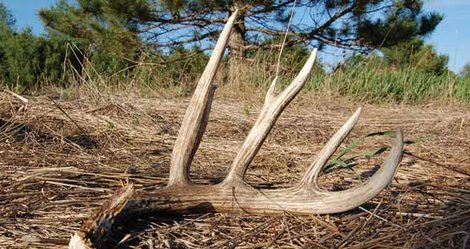
If you’re like most deer hunters, you spend the majority of your time in the woods during the fall and winter of each year. However, the habitat that deer live in, just like the animals themselves, are found there year-round — so get out and explore it, learn more about it, and find some shed antlers.
With spring just around the corner and whitetail bucks starting to shed antlers, there is a good opportunity to learn more about your hunting area and the deer that live there. Most hunters get excited when bucks start growing their antlers each year — it’s a chance to witness the impact of past management and look forward to future harvests. It really is something to get pumped up about.
But on the other hand, there are those hunters that get excited as the hunting season ends. It marks the fact that soon bucks will be dropping their coveted antlers. You know, there are ways to get a huge set of antlers on your wall other than shooting the big boy. He may have eluded you during the season, but you can still find his shed antlers!
Shed antlers also allow you to physically track bucks that you may have been keeping a close eye on. Measurements that can be taken from year to year include common measurements such as beam length, tine length, and mass measurements.
A few tips to increase your chances of finding deer sheds:
- Look in and around late-season food plots.
- Examine travel corridors and water sources.
- Use a game camera to ensure most bucks have shed.
- Don’t wait too long. Rodents will eat and destroy antlers due to the coveted minerals they contain. In addition, warming weather will spur grass growth and make finding antlers more difficult.
- Keep an eye out for new hunting locations.
Friday, February 3, 2012
Hunter shoots unusually large coyote in Northwest Missouri
 JEFFERSON CITY Mo – DNA tests show that a 104-pound canine shot by a hunter in Carroll County Nov. 13 was an unusually large coyote.
The hunter shot the big canine on opening day of Missouri’s November firearms deer season, thinking it was a coyote. Coyotes are legal game during deer season. However, when the hunter saw the animal’s size, he wondered if he had mistakenly shot a wolf. He reported the kill to Conservation Agent Marc Bagley. Bagley took possession of the animal and turned it over to the Missouri Department of Conservation’s (MDC) Resource Science Division for identification.
Resource Scientist Jeff Beringer said the MDC staff took measurements and collected tissue and hair samples for DNA analysis. The test showed the animal was a coyote.
According to Beringer, the coyote was a male approximately 3 years old. It had no tattoos, microchip or evidence of ear tags that would indicate it might have escaped or been released from captivity.
The coyote’s size and the size and shape of its feet were similar to those of a wolf, leading to speculation it could be a coyote-wolf hybrid. Gray wolves, also known as timber wolves, once inhabited northern Missouri but were gone from the state by the late 1800s, due to hunting and habitat loss. Wolves persisted in Minnesota. From there, they dispersed into Wisconsin and Michigan, which now have wolf populations of their own.
The last record of a gray wolf in Missouri was of a young male mistaken for a coyote and killed by a bowhunter in Grundy County in October 2001. A radio collar and ear tag linked that 80-pound wolf to Michigan.
The Wild Mammals of Missouri, the definitive text on Show-Me State mammals, indicates a normal weight range of 18 to 30 pounds for coyotes. However, much larger specimens have been documented in other states.
Wolves are a protected species in Missouri. According to the U.S. Fish and Wildlife Service, the grey wolf is listed as a federally endangered species in the lower 48 states, except in Minnesota and where there are non-essential experimental populations.
Beringer said the MDC has never stocked wolves and has no plans to restore them to Missouri.
Subscribe to:
Posts (Atom)